In February 2003, Kenya’s new justice minister led reporters into the basement of Nyayo House in central Nairobi and showed them small, dark cells. The building carried the slogan of Daniel arap Moi, who had left power six weeks earlier. For 24 years, the quiet former schoolteacher had asked Kenyans to follow in his footsteps.
The cells under Nyayo House
Nyayo House is a tall government building on a busy corner of the city. People still queue there for passports. Its name comes from Moi’s slogan, since nyayo is Swahili for footsteps. In February 2003, the justice minister Kiraitu Murungi called the basement a national monument of shame.
Former prisoners came back to stand in the rooms where they said they had been held. According to the Kenya Human Rights Commission, interrogations took place on the upper floors. The cells below were kept dark and were often flooded with water. Survivors such as Wachira Waheire, arrested in 1986, would spend decades taking the state to court.
A herd boy from the Rift Valley
Daniel Toroitich arap Moi was born in 1924 in Baringo, in the hills of the Rift Valley. His people were the Tugen, a small group within the Kalenjin. His father died when he was a small child, and he grew up herding goats and cattle. Then a mission school changed his life. He was baptised as Daniel, and the church stayed at the centre of his life.
He trained as a teacher and later became a headmaster. In 1955 the colonial government chose him as the African member for the Rift Valley in the Legislative Council. He was 31, devout and soft spoken. Many powerful men would later make the same mistake about him. They thought he was a man who would simply follow orders.
The loyal deputy nobody feared
Before independence, Moi helped lead KADU, a party of the smaller communities. After independence in 1963, KADU joined Jomo Kenyatta’s KANU. Kenyatta made Moi minister for home affairs and, in 1967, vice president. He held that post for more than eleven years.
To the men around Kenyatta, he looked harmless. In 1976 some of them campaigned to change the constitution, so that the vice president would not automatically take over. The attorney general, Charles Njonjo, declared the campaign illegal, and it faded. Kenyatta died on 22 August 1978. Moi became acting president, and in October he was sworn in as Kenya’s second president.
Peace, love and unity, then fear
Moi called his government Nyayo. At first, many Kenyans liked what they saw. In December 1978 he released all political detainees, among them the novelist Ngũgĩ wa Thiong’o. His government gave free milk to schoolchildren and opened new universities. Millions of Kenyans, especially in the countryside, still remember him that way.
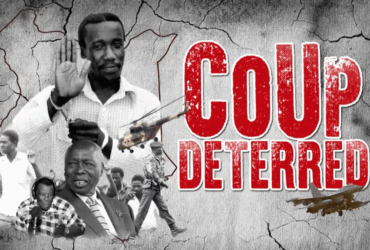
However, he had come to power without a base of his own. In June 1982 parliament made KANU the only legal party. Eight weeks later, on 1 August 1982, junior officers of the air force tried to seize power. They took the national radio station and announced the fall of the government. Loyal troops crushed the coup within hours. The official death toll was 159, while independent estimates ran much higher.
After the coup, the security state grew. Raila Odinga spent most of the next six years in detention without trial. Even Njonjo, who had once protected Moi’s succession, was accused of disloyalty and lost his place in the cabinet. In 1984, security forces rounded up men of the Degodia clan at the Wagala airstrip in Wajir. Years later, Kenya’s Truth, Justice and Reconciliation Commission said the dead were possibly close to a thousand.
Mwakenya, the queue vote and Robert Ouko
From 1986 the police hunted a small underground movement called Mwakenya. Lecturers, students and journalists were arrested and often charged late at night without a lawyer. Survivors say many were questioned in Nyayo House. Amnesty International reported torture in 1987, and the government denied it. In the 1988 party primaries, voters even had to queue in public behind photographs of their candidates.
In February 1990 the foreign minister, Robert Ouko, disappeared from his farm. His burned body was found days later near his home. Detectives from Scotland Yard investigated, and later a judicial commission. Moi dissolved the commission before it could report. To this day, nobody has been convicted of the killing.
Saba Saba and the return of many parties
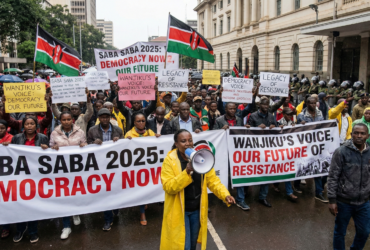
In 1990, Kenneth Matiba and Charles Rubia called for multiparty politics and planned a rally on 7 July, Saba Saba in Swahili. Both were detained, and protests spread across the country. Meanwhile, the Cold War was over, and Western donors no longer looked away. In November 1991 they froze new aid. A few weeks later, Moi accepted other parties.
Even so, he ruled for eleven more years. Clashes in the Rift Valley drove families from their land, and a parliamentary committee blamed local officials for inciting them. A divided opposition let Moi win in 1992 and 1997. At the same time, the Goldenberg scandal cost Kenya enormous sums through export claims for gold that was never exported.
Booed at Uhuru Park, mourned in 2020
The constitution limited him to two terms. In 2002 Moi chose Uhuru Kenyatta as his successor, but a united opposition won behind Mwai Kibaki. At the handover in Uhuru Park, the crowd shouted mwizi, thief, and threw mud at the stage. Still, for the first time, a Kenyan president left office through an election.
Moi died on 4 February 2020, aged 95, and thousands queued to see his coffin. By then, according to the Kenya Human Rights Commission, survivors of his years had won 179 torture cases against the state. He was neither a cartoon tyrant nor simply a gentle father of the nation. Below the passport queues, the basement of Nyayo House still waits to become the monument that was promised.
This article draws on the documentary by the YouTube channel The Iron Chair.
Photo: Daniel arap Moi with the Dutch prime minister Dries van Agt at Schiphol, 1979. Rob Croes/Anefo, Nationaal Archief, CC0.
Relaterede indlæg
 Kenyas historie – Tidslinje
En kronologi over vigtige begivenheder i det område, vi i dag kender som Kenya:
 Saba Saba 2025: Kenyas arv af modstand og kampen for demokrati
Saba Saba: Den Uforanderlige Ånd af Kenyansk Modstand
 Kenyas kupforsøg i 1982: udsendelsen, blodet og fødslen af en politistat
Ved daggry den 1. august 1982 vågnede kenyanske borgere op til en stemme, der ikke var præsidentens.